
thumbnail image

Water Security is National Security

  • Home
  • Primal Water
  • Our Method
  • Success Cases
  • Process
  • Pricing & Guarantee
  • Team
  • Wells of Hope
  • FAQ
  • Contact Us
  • …  
    • Home
    • Primal Water
    • Our Method
    • Success Cases
    • Process
    • Pricing & Guarantee
    • Team
    • Wells of Hope
    • FAQ
    • Contact Us

    Water Security is National Security

    • Home
    • Primal Water
    • Our Method
    • Success Cases
    • Process
    • Pricing & Guarantee
    • Team
    • Wells of Hope
    • FAQ
    • Contact Us
    • …  
      • Home
      • Primal Water
      • Our Method
      • Success Cases
      • Process
      • Pricing & Guarantee
      • Team
      • Wells of Hope
      • FAQ
      • Contact Us
      • Using Deep Water Resources to Address National Water Security
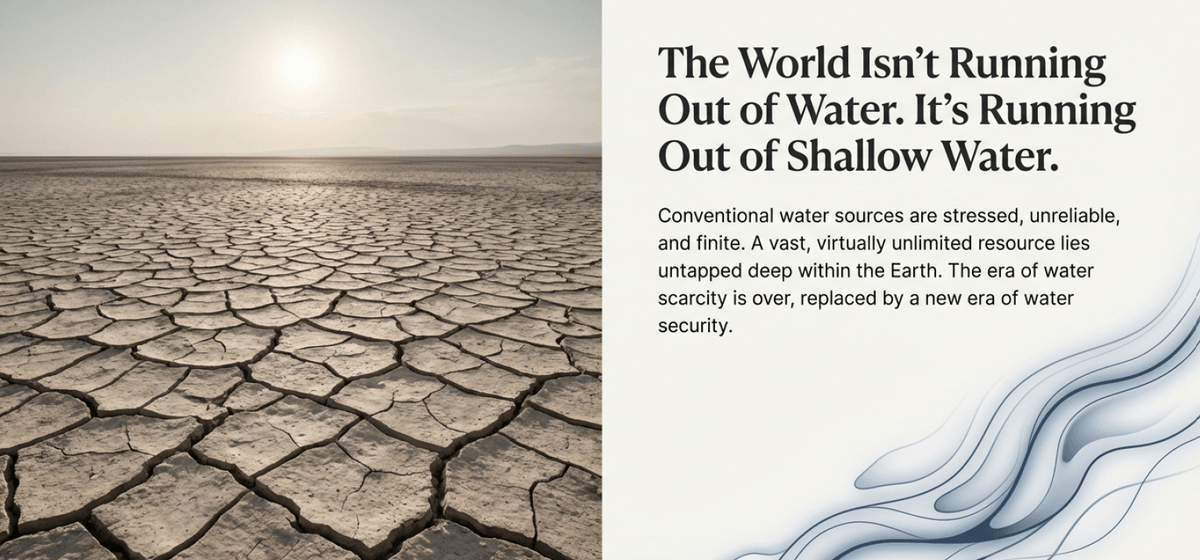
      • Introducing Primal Water

        Huge Quantities of Fresh Water Exist Deep Underground ...more water than in all the Oceans of the World.

        • An estimated 22.6 million cubic kilometers of groundwater are stored within the upper two kilometers of the Earth’s crust alone, according to data from U.S. National Ground Water Association.

        • Current global freshwater consumption is ~3,700 cubic kilometers per year, yielding over 6,000 of years of available subterranean water supply based on known reserves.

        • Scientific research further indicates that the Earth’s mantle may contain up to 5 times more water than all surface oceans combined, as reported by Scientific American and corroborated by peer-reviewed geophysical studies.

        • This mantle-derived water, commonly referred to as “Primal Water” is naturally fresh and non-saline, having never participated in the surface hydrological cycle.

        • Primal Water lacks deuterium (²H) and tritium (³H), isotopic markers that are present in surface and shallow groundwater due to atmospheric exposure, confirming its deep-earth origin and natural purity.

        • Our problem is NOT water availability. It's economic access. The challenge lies in identifying locations where deep-earth water migrates close enough to the surface to enable cost-efficient extraction.

        • Deep Earth Water ("DEW") specializes in precisely this challenge, employing advanced geophysical analysis and precision drilling to identify shallow access points to deep-earth water systems.

        • Through its partners, DEW has successfully identified and developed over 1,000 Primal Water wells globally.
      • Our Method: 97% Success Rate Across 1000+ Wells

        Through its partners, DEW has a 97% Success Rate stands in stark contrast to the 40% industry average, achieved through a synthesis of proprietary technologies.

        Section image

        Data Synthesis

        High-resolution satellite imagery, airborne geophysical surveys, and Al-driven predictive algorithms.

        Section image

        Precision Targeting

        Remote sensing technologies identify optimal drilling locations within a narrow 9-foot target.

        Precision Targeting Yields our Proven Results

        Section image

        Successful Extraction

        Efficient and cost-effective extraction of high-yield, fresh water from the identified source.

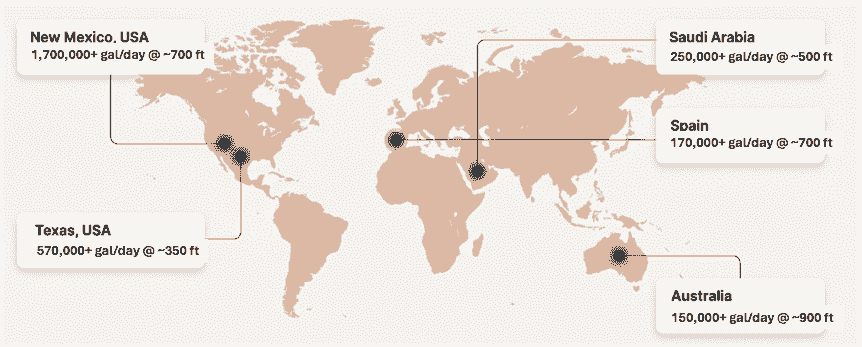
      • Global Validation: High-Yield Wells

        in the World's Toughest Environments

        Deep Earth Water and its partnershave drilled worldwide, proving their expertise in locating and extractinghigh-yield, freshwater from deep earth aquifers
        Section image
      • Finding Water

        Where No One Else Can

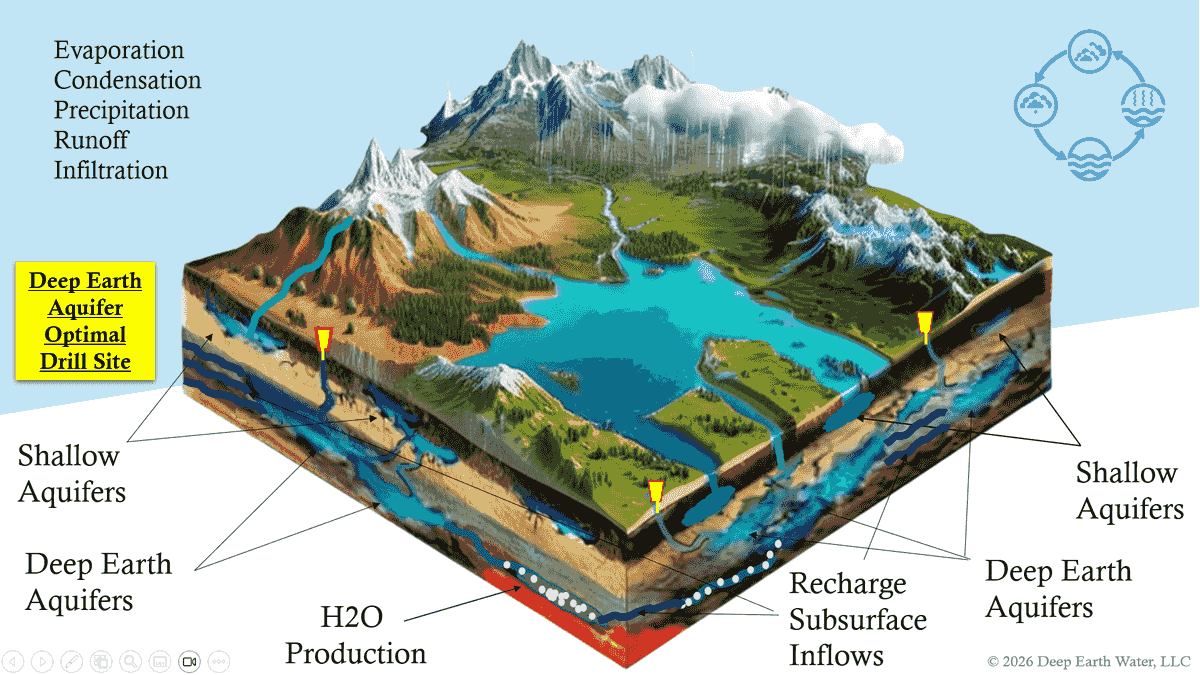
        • The conventional hydrological cycle describes how surface water is evaporated by solar energy, condenses into clouds, precipitates as rain, and recharges rivers, lakes, and shallow aquifers. This system is are inherently dependent on climate and increasingly vulnerable to water depletion and contamination.

        • Independent of this surface cycle, a separate and substantially larger source of fresh water exists deep beneath the Earth’s surface. Geological and chemical processes within the Earth generate hydrogen and oxygen, which combine under extreme heat and pressure, cool within the mantle, and form liquid water.

        • This mantle-water migrates upward under immense pressure through fractures, faults, and fissures within the mantle and Earth’s crust, forming deep-seated water systems that are naturally protected from surface contamination.

        • Our primary challenge is not water availability, but water accessibility. While most deep-earth water remains economically unreachable, specific geological conditions allow this water to rise close enough to the surface to enable cost-effective extraction.

        • Deep Earth Water, LLC specializes in identifying these shallow access points, typically at depths of less than 1,000 feet, using advanced geophysical analysis, proprietary modeling, and precision drilling methodologies.

        • Through its operating partners, DEW has successfully identified and developed more than 1,000 producing fresh-water wells in regions widely believed to contain no viable water resources.

        • These wells consistently deliver production volumes ranging from approximately 20,000 gallons per day to more than 1.5 million gallons per day, providing reliable, non-saline water supplies in arid, stressed, and previously undevelopable locations.
        Section image
      • Pricing & Guarantee

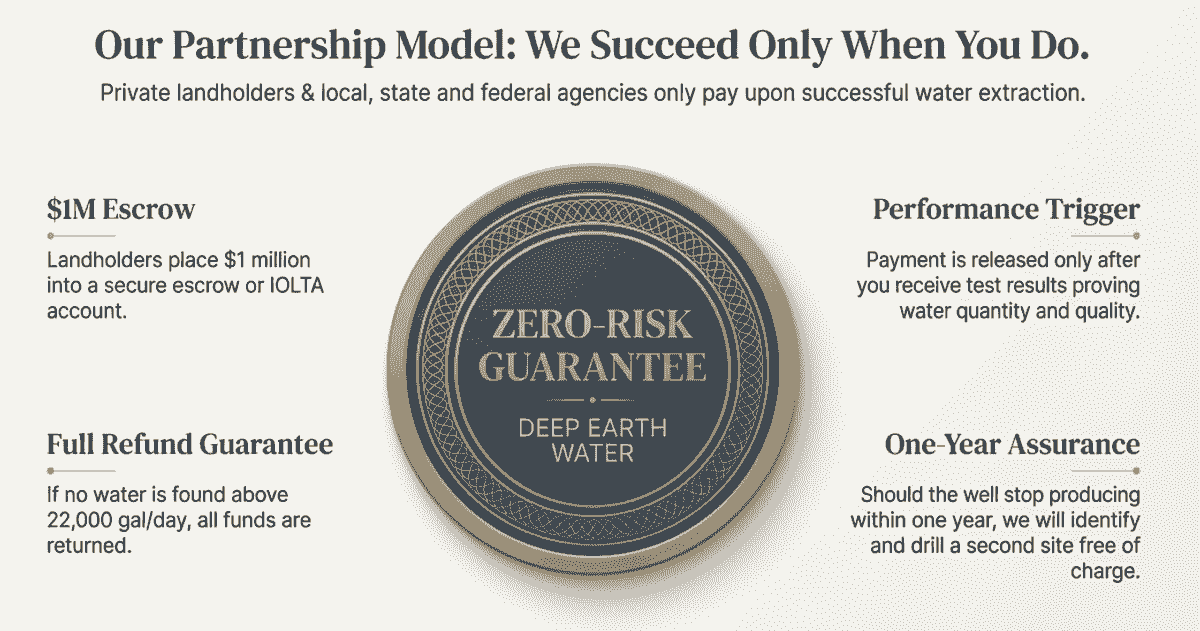
        • DEW will only receive payment when it finds water on your land and proves to you both quantity (volume) and quality (fresh, not saline).

        • DEW’s pricing is based on volume production — meaning the amount of water successfully extracted from the well.

        • Clients do not pay upfront for services; instead, payment is only required after verified test results prove the water’s quantity and quality.

        • This performance-based pricing ensures zero financial risk to landowners and incentivizes DEW to deliver high-yield, fresh water sources.

        • No water, No payment. That's our guarantee.

        OUR PRICING:

        • Tiny well: A well with less than 22,000 gal/day (less than 16 gpm) of fresh water, the well is free.

        • Small well: A well with 22,000 - 50,000 gal/day (16–35gpm), the well cost $800,000.

        • Medium well: A well with 50,000 - 150,000 gal/day (36–104gpm), the well cost $900,000.

        • Large well: A well with 150,000- 1,000,000 gal/day (105–695gpm), the well cost $1,000,000.

        • Extra-Large well: A well with over 1,000,000 gal/day (695+ gpm), the well cost $1,500,000.
        Section image
      • Team of Water Experts


        Section image

        Benjamin Blumenthal

        Founder & CEO - Water Expert

        Benjamin Blumenthal has over 25 years of financial services and entrepreneurial experience in the water sector. Over the years, he has presented viable water solutions to and received support from, the White House, Pentagon, US State Department, NATO and several foreign governments. He served as the vice president of technology for Bristol Investment Group in New York where he led the company’s investment in and raised the start-up capital for several technology companies as well as for Vitamin-Water, a local bottled water company that was subsequently sold to Coca Cola in 2007 for $4.1 billion. Prior to his work at Bristol, Mr. Blumenthal served as a client strategist at HomeCom Communications, a technology solutions provider for large financial institutions including HSBC, AIG, UBS, Bear Stearns and other leading financial institutions. Mr. Blumenthal studied at Oxford University in England, has a BA from Emory University and an MBA from Emory’s Goizueta Business School. Mr. Blumenthal is also Fund Director registered by the Cayman Islands Monetary Authority “CIMA”.

        Section image

        Rik Segers

        Board Member - Water Expert

        Rik Segers, a seasoned leader in sustainability and innovation, brings over 20 years of expertise in the water treatment industry to his role as Technical Advisor. With a focus on applying biotechnology for environmental preservation, he has driven impactful projects in wastewater treatment, soil remediation, and manure management, utilizing microorganisms to enhance natural processes and reduce emissions. His leadership at Biologeco and Bioma Bulgaria reflects his commitment to 100% chemical-free, GMO-free solutions for municipal, industrial, and residential applications. By pioneering smart water management through data analytics and IoT, Rik optimizes water usage and enhances resource management efficiency. His career spans strategic environmental projects across Europe, the Middle East, and Africa, showcasing his dedication to ecological stewardship and business transformation. Passionate about creating a sustainable future, Rik invites collaboration to drive meaningful, long-lasting environmental impact.

        Section image

        HRH Prince Michel of Yugoslavia

        Senior Advisor - Deal Specialist

        HRH Prince Michael ofYugoslavia, also known as Michel de Yougoslavie, is a distinguished investment executive, socialite, and philanthropist with deep royal heritage as the grandson of Princess Olga of Greece, Grandson of King Emanuele of Italy and great grandson of King Leopold of Belgium. Born in 1958, he has built a notable career in the investment world, channeling his expertise into philanthropic initiatives across Europe. His connections to both the Serbian, Greek and Italian royal families enhance his influence and dedication to fostering cultural and charitable efforts. A respected figure in social and business circles, Prince Michael combines his aristocratic background with a commitment to impactful community projects and investment leadership.

        Section image

        Nicolas Giannakopoulos

        Senior Advisor - International Finance

        Nicolas Giannakopoulos is an executive with over 20 years of financial services experience. He has helped to secure over €500M in direct investments in responsible mining, water resources, financial systems and other transnational investments. He is the President and Co-Founder of the Organized Crime Observatory (OCO) and served as the Director of MILES SA, a Swiss-based investigation company. He has participated in numerous research programs including those financed by the Swiss Confederation. He was awarded the Medal of Merit by the Brazilian judicial authorities for his professional achievements.

      • Wells of Hope Initiative

        Section image
      • FAQ

        Do I pay anything if you don't find water?

        No. Not a thing. We only get paid when we find water on your land and prove to you both quantity (volume) and quality (fresh, not saline). DEW’s pricing is based on volume production — meaning the amount of water successfully extracted from the well. Clients do not pay upfront for services; instead, payment is only required after verified test results prove the water’s quantity and quality. This performance-based pricing ensures zero financial risk to landowners and incentivizes DEW to deliver high-yield, fresh water sources. No water, No payment. That's our guarantee.

        How is Deep Earth Water’s pricing structured?

        Tiny well: A well with less than 22,000 gal/day (less than 16 gpm) of fresh water, the well is free.

        Small well: A well with 22,000 - 50,000 gal/day (16–35gpm), the well cost $800,000.

        Medium well: A well with 50,000 - 150,000 gal/day (36–104gpm), the well cost $900,000.

        Large well: A well with 150,000- 1,000,000 gal/day (105–695gpm), the well cost $1,000,000.

        Extra-Large well: A well with over 1,000,000 gal/day (695+ gpm), the well cost $1,500,000.

        How deep do you typically drill and how long does it take?

        Nearly all of our sites are less than 1,000 ft in depth and typically take only 5 days to find and successfully drill. Another week to test, and the process is usually done within 2 weeks. Complicated sites can take up to 2 months, but that is rare.

        What is Deep Earth Water (DEW) and what does it do?

        DEW locates and extracts high-yield, non-saline, fresh water from deep-earth aquifers using advanced geological mapping, AI-driven analytics, and precision drilling. It delivers sustainable water to landowners, governments, and developers.

        What is “Primal Water” and how is it different from groundwater?

        Primal Water is pure water that naturally rises from deep within the Earth’s mantle through geological fissures. Unlike traditional groundwater, it’s uncontaminated, non-saline, and self-replenishing with no environmental depletion risk.

        Is the water potable?

        Primal Water is naturally clean when it forms deep underground. However, as it travels toward the surface, it can pick up minerals or contaminants from the surrounding rock and soil. For this reason, the water is treated and filtered, just like water from traditional wells, before it is considered safe to drink. Once standard treatment is applied, the water would meet potable water standards.


        How successful is DEW in finding water?

        Through its partners, DEW has a 97% success rate, far exceeding the 40% industry average. Over 1,000 wells have been drilled using a precise 9-foot target zone, often finding water at depths between 500–1,000 feet.

        What is the process for getting water on my land?

        Sign Water Extraction Agreement.

        Deposit $1 million into escrow or IOLTA.

        DEW schedules onsite evaluation (within 30 days).

        Drilling and discovery typically completed within 2 weeks.

        Water is tested for volume and quality.

        If successful, funds are released after test results.

        If the well fails or yields <22,000 gal/day, the deposit is refunded.

        What if the well stops producing water after drilling?

        If the well stops producing within 1 year, DEW will drill a second site free of charge.

        Who pays and when?

        Landowners pay only if water is successfully found and tested. Payment is due after receiving verified water quality and quantity test results. This makes it a zero-risk model for clients.

        What are the water output levels from DEW wells?

        Example yields from global projects:

        New Mexico: 1.7M+ gal/day @ ~700 feet

        Texas: 550,000+ gal/day @ ~350feet

        Saudi Arabia: 250,000+ gal/day @ ~500 feet
        These show substantial water output at relatively shallow depths.

        What can I do with the water once it’s found?

        Use it locally (agriculture, property enhancement), store it, or distribute it regionally using trucks, pipelines, or modular systems. DEW water boosts land value and opens up strategic use options.

        Are there any tax incentives or carbon credits available?

        Yes. Potential benefits include certain deductions, conservation easements, cost-sharing, and carbon credits for water-efficient upgrades — which can create new revenue streams.

        Does this impact the environment negatively?

        No. Primal Water is geologically replenished and does not deplete aquifers or damage ecosystems. DEW’s operations are sustainable and environmentally responsible.

        How do I learn more?

        Contact Us for further details.

      • Contact Us

        For more information or subscription documents

        Dallas, Texas
        9am - 5pm CST
        (Central Standard Time)
        +1 (424) 644.5383
        +1 (424) 644.5383
        bb@deepearthwaterllc.com

      © 2026 Deep Earth Water, LLC . All rights reserved.

        Cookie Use
        We use cookies to ensure a smooth browsing experience. By continuing we assume you accept the use of cookies.
        Learn More